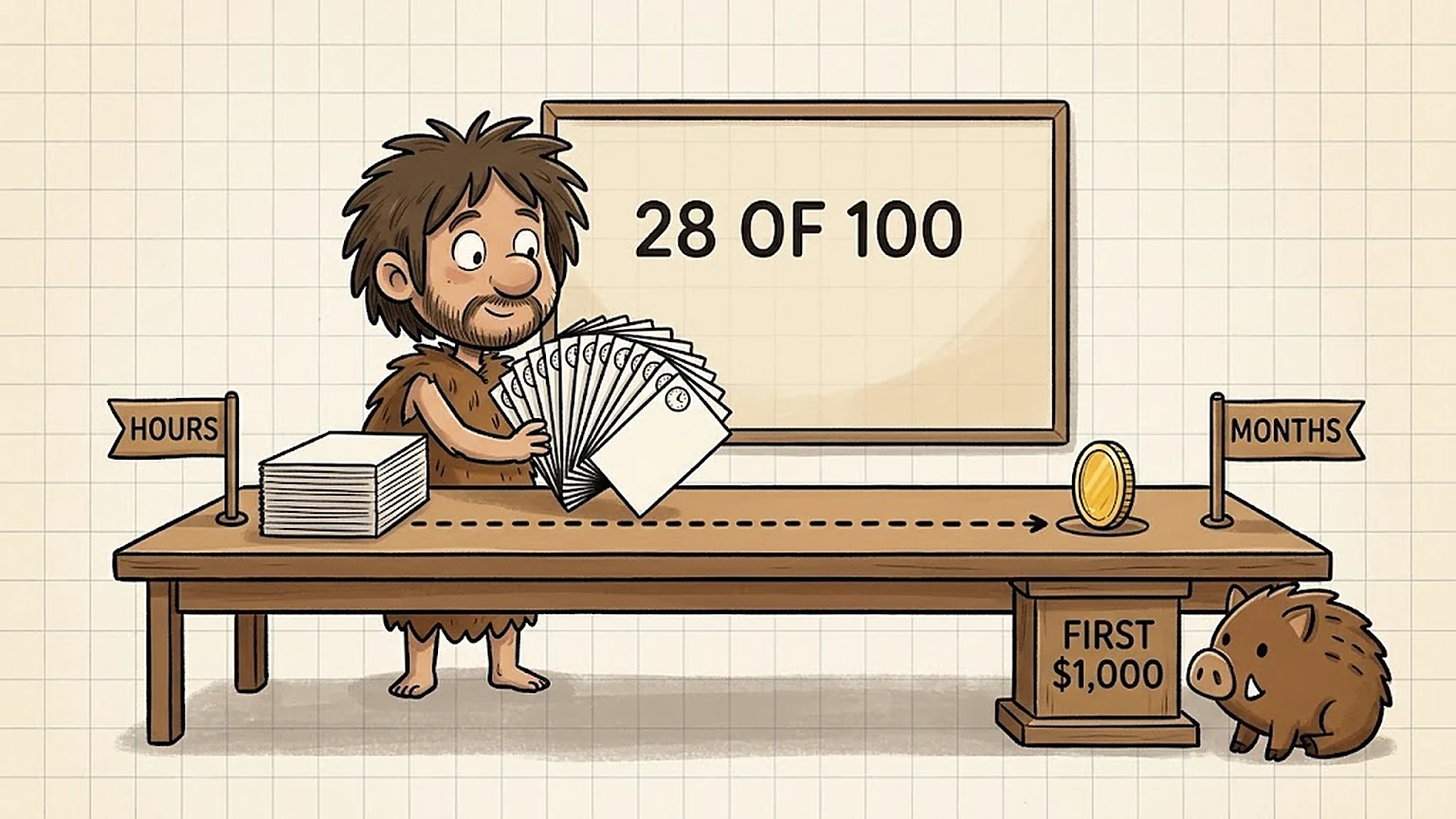
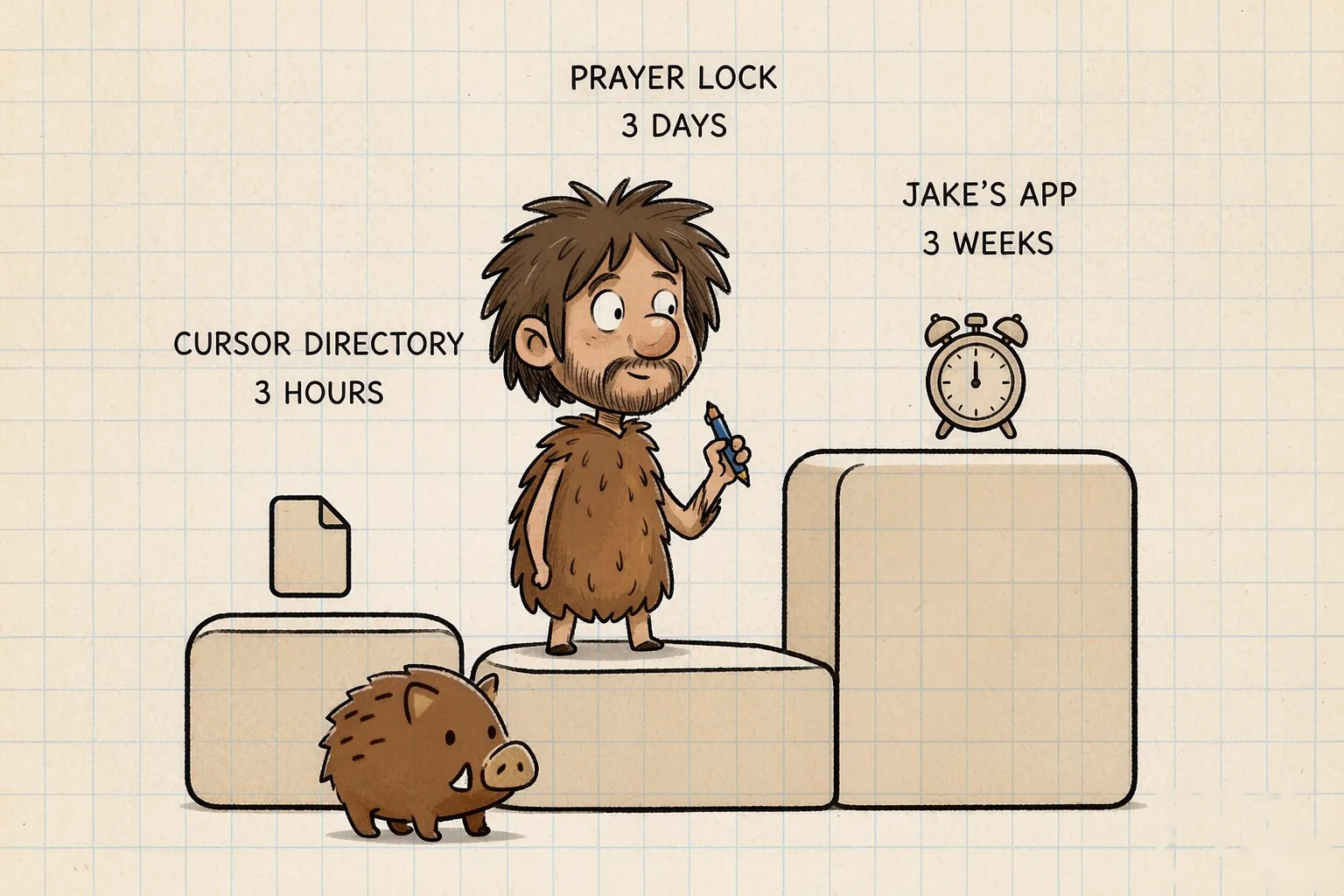
The short version: The fastest product in this dataset shipped in three hours. The slowest took three weeks. Every one of them cut the same category of thing, and every one of them kept the same thing: a single loop the user could finish. None of them said they cut too much. Two had to go back: one was missing the hook, the other had built the wrong outcome.
I went through the dataset looking for founders who described their first version as embarrassingly small. Eight teams did, in enough detail to compare. Their build times ranged from three hours to three weeks. Most stayed under $35,000 a month; one reached $50,000.
This is not an argument for shipping garbage. It is an argument for knowing which part of the product is the product.
Three hours to three weeks
The range is wider than most advice suggests.
Product | Build time | What it was at launch |
|---|---|---|
|
Cursor Directory |
3 hours |
A single page listing Cursor rules |
|
AudioPen |
12 hours |
One record button |
|
LaunchFast |
48 hours |
One product-research function |
|
Yaphone |
One weekend |
A web dialer |
|
Prayer Lock |
3 days |
Pick an app, pray, unlock |
|
PushScroll |
2 weeks |
Three screens |
|
EUform |
2 weeks |
Fields plus CSV export |
|
Jake's alarm app |
3 weeks |
An accountability app with no alarm |
Three hours is not a typo. The founders of Cursor Directory built it after a flight landed, put a list of rules on a page, and shipped. That page later reached 2.2 million visitors and about $34,000 a month, with a 99.8% gross margin and roughly three hours of maintenance a month.
The lesson is not "three hours is enough." The lesson is that the build time tracked the size of the loop, not the ambition of the product.
*Write down your build time. If it is measured in months and you have not shipped anything yet, the loop is probably too big.*
What they cut
Every founder cut the same kinds of things.
Product | Cut | Kept |
|---|---|---|
|
PushScroll |
UI polish, scaling architecture, social features |
Detect the exercise, block the app, unlock |
|
AudioPen |
Editing, layout, pages, settings |
Press record, get clean text |
|
Prayer Lock |
Sign-up and database entirely |
Pick app, pray, unlock |
|
EUform |
90% of Typeform's features, landing page, logo, integrations |
Collect fields, export CSV |
|
Jake's alarm app |
The alarm itself, shipped without one |
A daily accountability log |
|
Cursor Directory |
Everything except a list |
Search a rule, copy it |
|
LaunchFast |
Analytics module, complex UI |
Enter a keyword, get a product verdict |
|
Yaphone |
Social features, settings |
Open the page, make a call |
Look at the third column. None of those are features. They are verbs. Every product can be described as "the user does X, and gets Y," and in all eight cases, nothing else was required for that sentence to be true.
The most extreme case is Prayer Lock. Matt cut the sign-up system and the database. All data lives on the device. There is no account to recover, no server to pay for, no onboarding email. That decision would get flagged in most product reviews. It also produced 58,000 downloads in six months and about $20,000 a month.
*List every feature you think you need. For each one, ask: if I delete this, does the sentence "the user does X and gets Y" still work? If yes, delete it.*
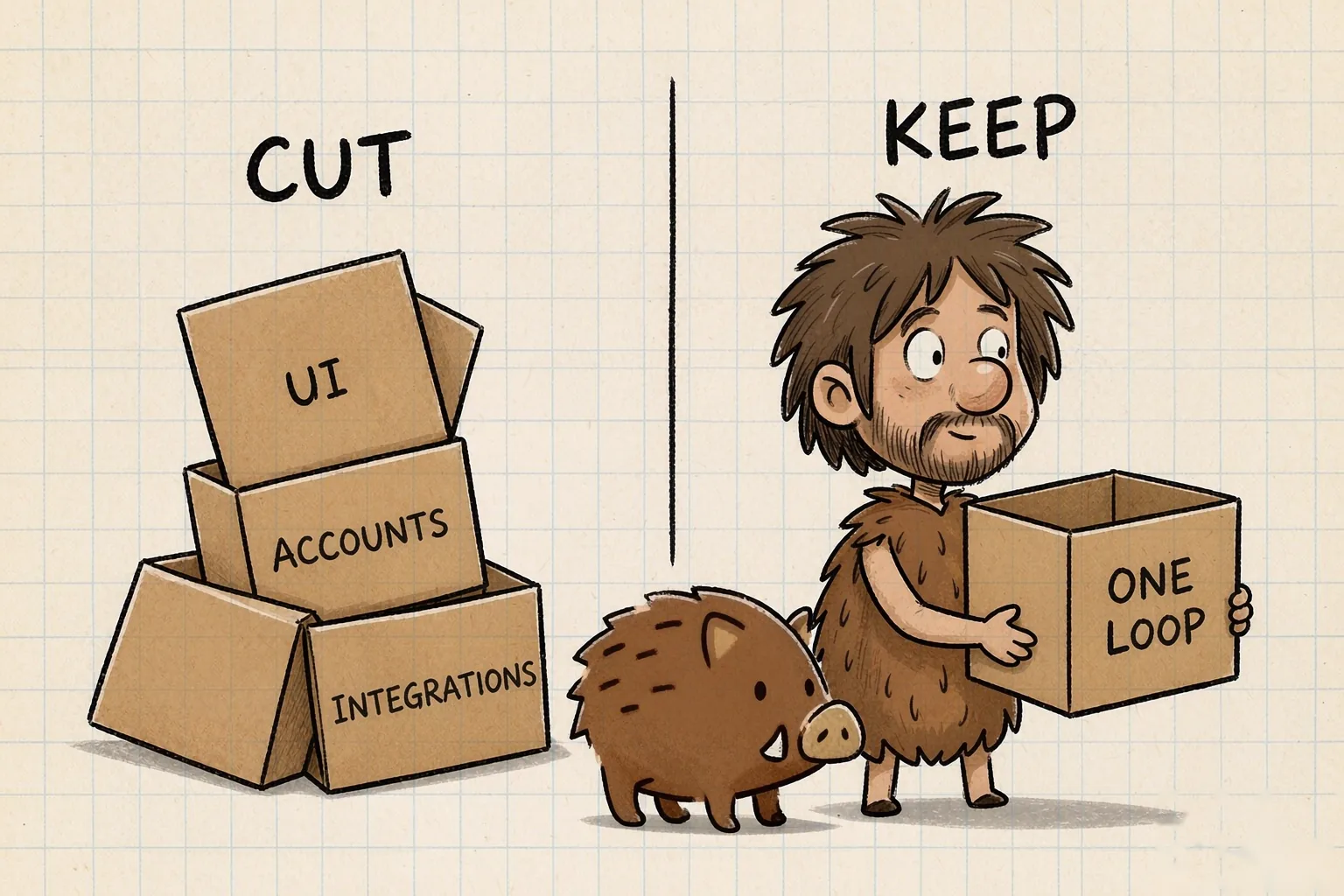
What they kept: one loop you can say in a sentence
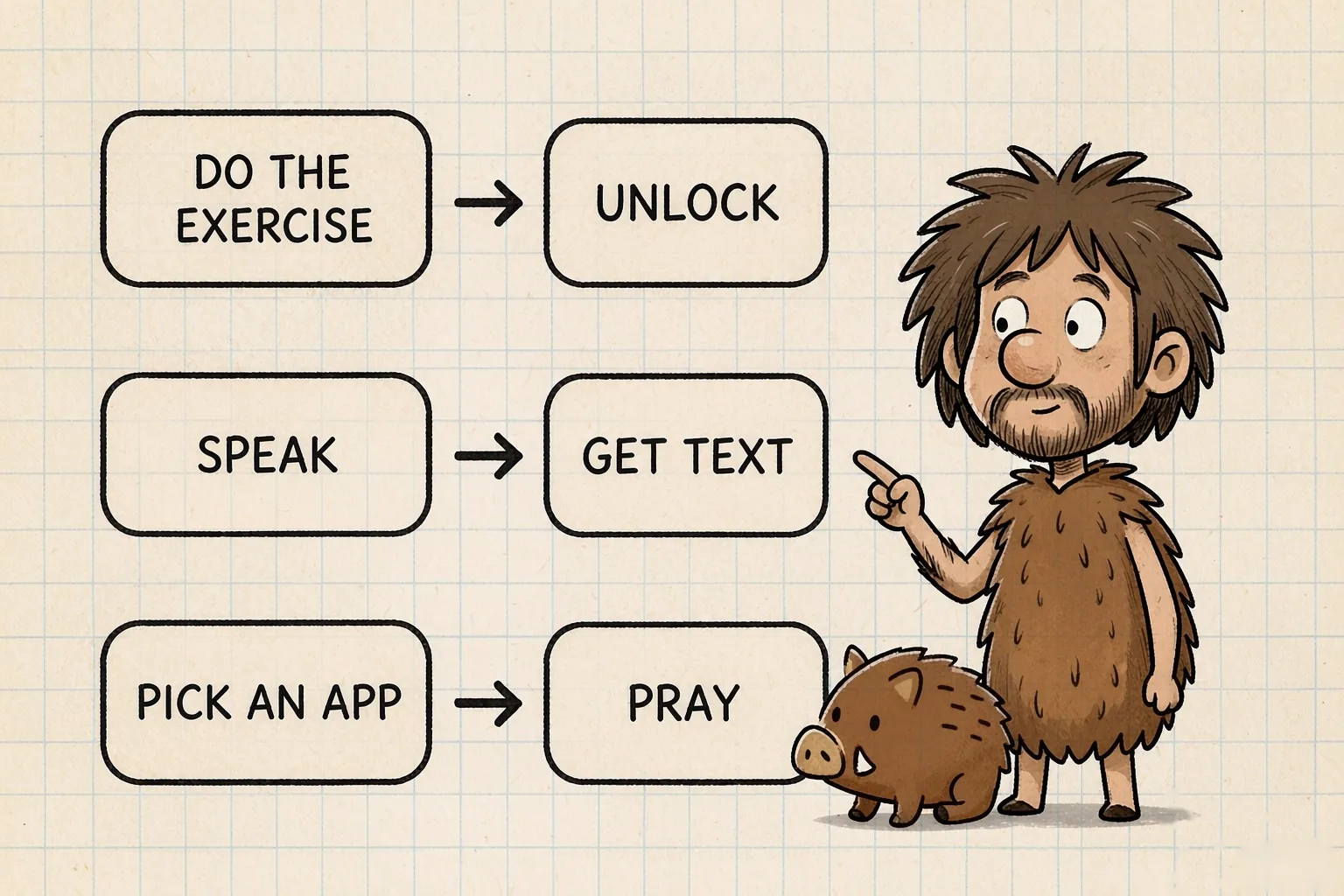
Here is the same eight products, reduced to their loop.
Product | The loop |
|---|---|
|
PushScroll |
Do the exercise, unlock the app |
|
AudioPen |
Speak, get text |
|
Prayer Lock |
Pick an app, pray, unlock |
|
EUform |
Collect fields, export CSV |
|
Jake's alarm app |
Set a goal, log the wake-up |
|
Cursor Directory |
Search a rule, copy it |
|
LaunchFast |
Enter a keyword, get a verdict |
|
Yaphone |
Open the page, make a call |
The test is not "is this feature important." The test is "does the loop still close without it."
PushScroll's founders put it more bluntly than any framework would.
"Our MVP was literally three screens: a half broken push-up detector, a screen to choose what apps you want to block, and a screen that blocks those apps unless you've exercised."
A half-broken detector is still a detector. The loop closed. The polish did not exist, and nobody cared.

Nobody in this dataset regretted cutting features
This is the part I expected to find and did not.
I looked for founders who cut something, shipped, and later admitted the cut was a mistake. In 100 interviews, that story does not appear. What appears instead is two founders who shipped a product that solved the wrong version of the problem.
PropGPT is not one of the eight. It is the counter-example. It built a tool that asked users to look up their own betting data and enter it manually. The product worked. Users did not want it.
"45% conversion to trial but then only 13% conversion from trial to paid. What does that mean? Everybody wondered what we were selling, but the product was shit."
The founders stopped marketing and spent four months rebuilding around one change: give the answer directly instead of asking the user to find it.
"What our customers actually wanted was just to be given the right answers to the test, and not necessarily go through the sports books and input their bets."
After the rebuild, conversion to paid went over 50%, and they hit a $40K monthly peak.
Jake's alarm app shipped as an accountability app with no alarm in it. Three weeks to build, then a wall: he did not know how to market it. Nineteen days after launch, he added the alarm.
"The initial scope of the project was just an accountability app, so there was no alarm feature whatsoever... the alarm feature went live about another 19 days after it was on the app store."
With the alarm, the product had a hook. Four months later it was at $50,000 a month.
Neither founder cut too much. Both shipped a loop that closed around the wrong thing. That is a different failure, and it is the one worth fearing.
*If your MVP is not selling, do not add features until you know which problem you have: a missing hook or a missing outcome.*
How ugly can it be?
Uglier than you would ship on purpose.
PushScroll launched with three screens and a detector the founders describe as half broken. Their rule:
"If it's ugly, it's okay. It doesn't have to scale."
Two things made that acceptable. First, the loop was real: do the exercise, the app unlocks. Second, demand existed before the code did. They posted a fake demo on TikTok first.
"There were people literally begging us in the comments to build this app."
That is the trade. Ugly is survivable when the outcome is obvious and someone already wants it. Ugly is fatal when the value is unclear and the product has to explain itself through design.
They also charged from the first day for everyone past the early users.
"We gave it away for free to the first users, but everyone else saw a hard paywall. That's the ultimate validation, that people will pay for your app."
*Before you polish anything, publish the ugliest version that completes the loop. If nobody wants it, the polish was never the problem.*
When to add the missing piece
Both fixes above have a timeline worth copying.
Case | What was missing | Time to fix | Result |
|---|---|---|---|
|
PropGPT |
The answer, not the tool |
4 months of engineering, no marketing |
Conversion to paid 13% → 50%+; $40K peak |
|
Jake |
The alarm |
19 days after launch |
$50K/month by month four |
The difference is diagnostic. Jake's product had a working loop and no hook, so adding one feature was enough. PropGPT's product had a working loop pointing at the wrong outcome, so it needed a rebuild.
Before you add anything, name which one you have. A missing hook gets a feature. A missing outcome gets a rebuild.
How to find your minimum this week
- Write the loop as one sentence. "The user does _ and gets _." If you need a second sentence, you have two products.
- List everything that is not required for that sentence. That is your cut list, not your backlog. Ship without it.
- Pick the one thing you will not cut. It is not a feature. It is the step where the user receives the outcome. For PushScroll it was the unlock. For AudioPen it was the text.
Then ship, and watch whether people finish the loop. Completion is the clearest signal that the loop is real. Everything else is feedback about the wrapper.
FAQ
How long should an MVP take to build?
In this dataset, three hours to three weeks. The build time tracked the number of steps in the loop, not the size of the ambition. If yours is taking months, cut steps before you cut quality.
What can I cut from an MVP?
Polish, accounts, dashboards, settings, integrations, and analytics. All of those appear in the cut column above, including a case where the founder removed sign-up and the database entirely.
What should I never cut?
The step where the user gets the outcome. Every product here has exactly one, and it is the only part that has to work on day one.
How do I know my MVP is too small?
If nobody finishes the loop, it is not too small, it is unclear or wrong. If people finish it and do not pay, that is a pricing question, not a size question. This piece on when to start charging covers that decision.
Does this apply before I have an idea?
No. If you have not picked a direction yet, the order is different: sell before you build, then build the smallest thing that delivers on what you sold.
---
If you are still choosing what to build, the free SaaS idea validation checklist is the place to start.
*The interviews in this piece come from public founder interviews. Figures are the founders' own, as stated in their interviews. This is a sample of founders who were interviewed because they built something, not a random sample of all products.*