The short version: Five founders in this dataset changed how they charged. Two moved to a hard paywall; three moved to a lifetime price or a subscription. Most of them measured something before or during the switch. What none of them can tell you is a story about a hard paywall that failed because nobody paid. In this dataset of 100 founder interviews, that story does not appear once.
I went through every conversation in the dataset looking for paywall decisions: who charged from day one, who gave it away, who changed their mind. The failures clustered on one side. Not the charging side. The free side.
The hard paywall vs freemium debate usually gets argued with industry averages. This piece argues it with individual decisions, including the ones that went badly.
This is a sample of founders who were interviewed because they built something that worked. Treat what follows as patterns, not base rates.
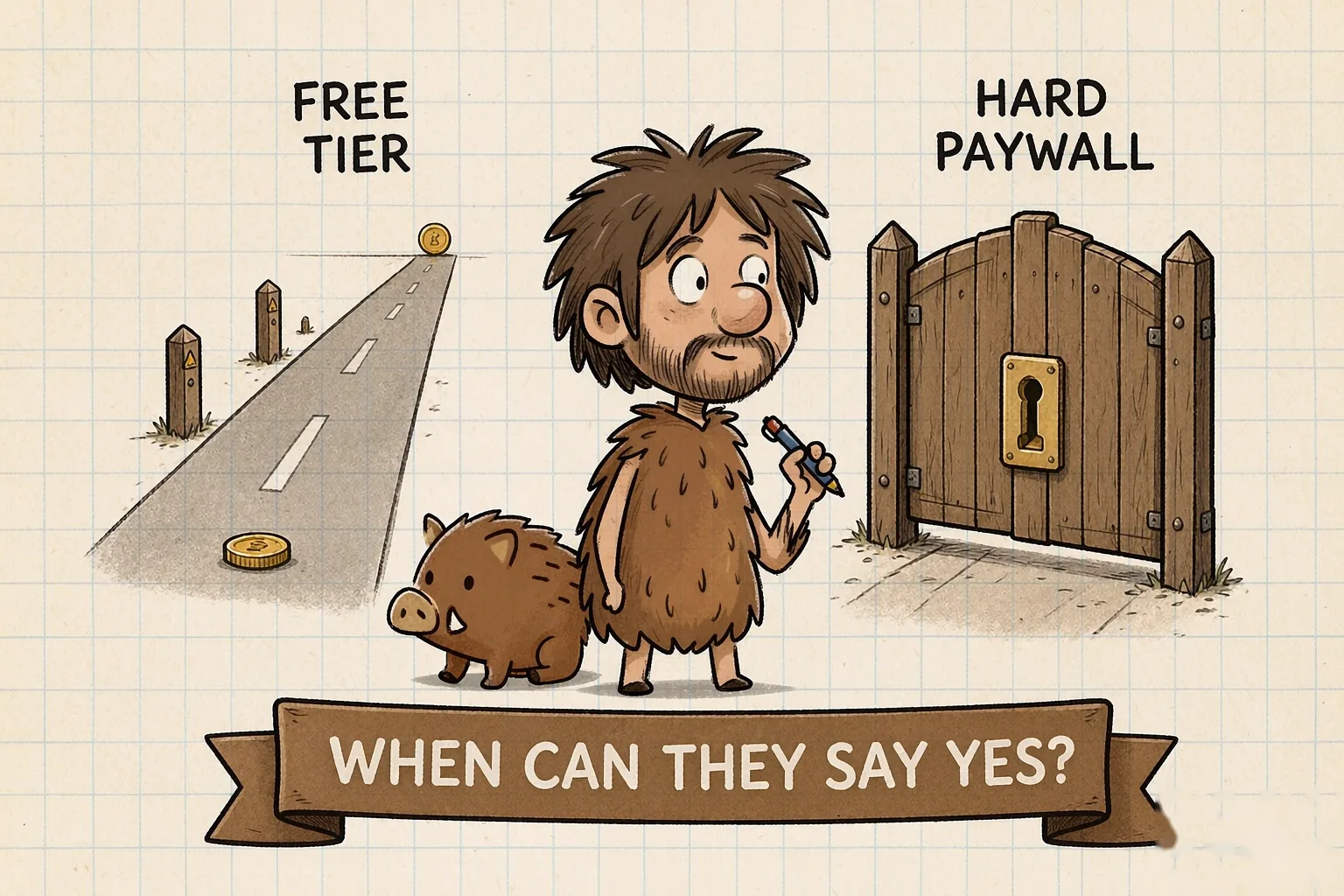
Where the failures actually happen
Five founders described a pricing model that did not work. Four of the five failed on the free side. The fifth, Save Wise, charged from day one and still failed, because users rejected the subscription itself.
PropGPT gave away a seven-day trial and bought traffic through influencers. Plenty of people downloaded it. Almost none of them stayed.
"45% conversion to trial but then only 13% conversion from trial to paid. What does that mean? Everybody wondered what we were selling, but the product was shit."
The founders shut off marketing and spent four months rebuilding the product. When it relaunched, conversion to paid went over 50%, and two and a half months later they hit a peak of $40K MRR.
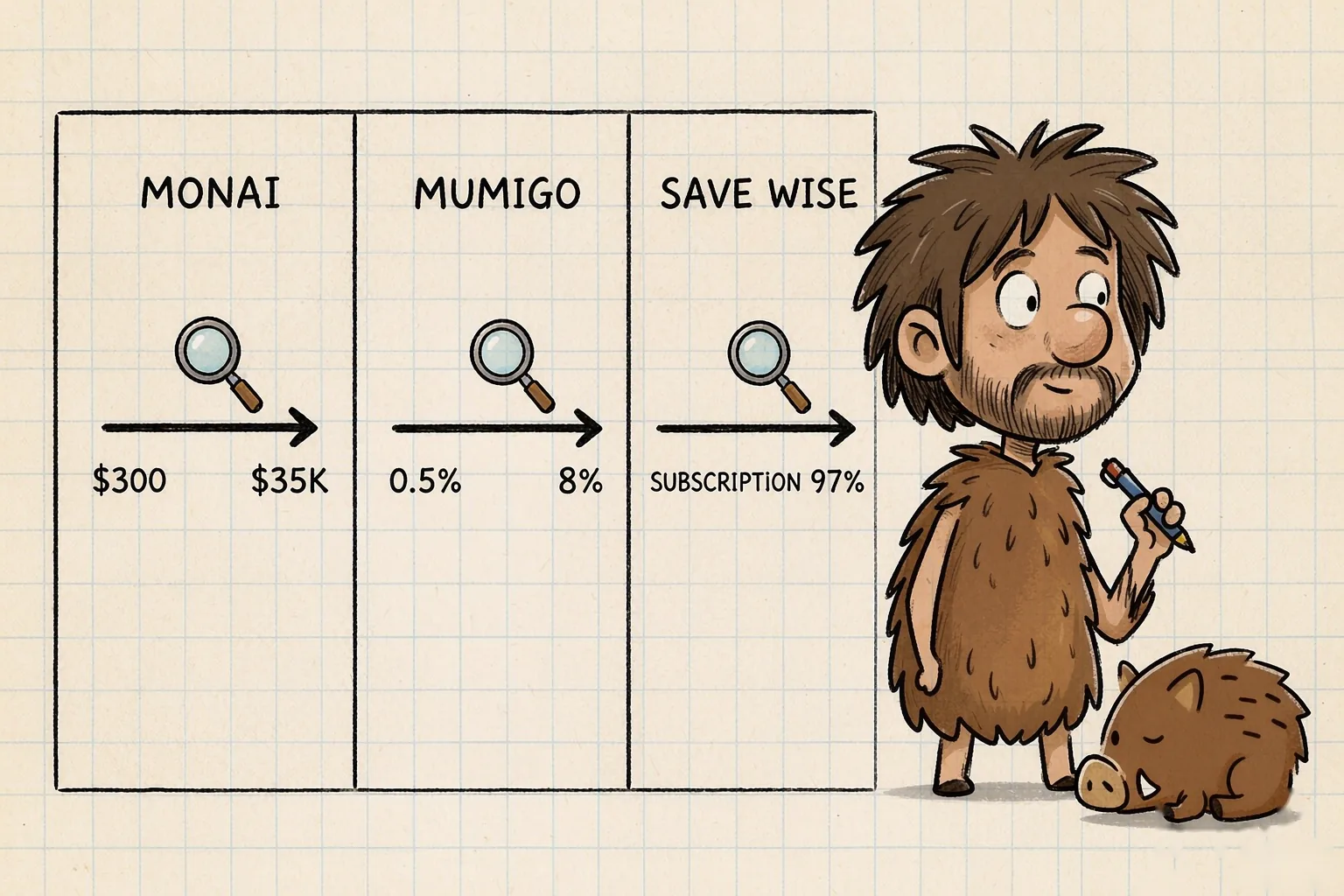
Monai ran a free tier for a year and a half. After 18 months, revenue was $300 a month.
"I launched it around three years ago and spent around one and a half years scaling it to $300 of MR by myself."
Save Wise launched with a monthly and annual subscription. The day it went live, users wrote in asking to pay for two years upfront instead. They did not want another subscription. They asked for a lifetime membership instead.
"Consumers hate subscriptions."
About 97% of revenue now comes from the lifetime plan rather than the monthly or yearly one.
Rabbit Holes AI launched a web app with a free trial and a monthly plan, and paid the AI API bill itself.
"Got some interest but never really turned into any real dollars."
Bible Buddy ran on WhatsApp before it had its own app. The founder did not know the platform charges per conversation window.
"My cost ballooned to like 15k a month. I was like, hell no, I need to move on my own infra."
Product | What it charged | Where it broke | What happened |
|---|---|---|---|
|
PropGPT |
7-day trial plus paid influencer traffic |
Trial-to-paid at 13% |
Rebuilt for 4 months; conversion went over 50% |
|
Monai |
Free tier |
18 months at $300 a month |
Switched to a hard paywall with a 7-day trial |
|
Save Wise |
Monthly and yearly subscription |
Users rejected the subscription itself |
97% of revenue moved to a lifetime plan |
|
Rabbit Holes AI |
Free trial plus monthly plan |
No real revenue, plus API costs |
Desktop app, one-time price, AI costs pushed to users |
|
Bible Buddy |
Free and low-cost chats on WhatsApp |
$15,000 a month in WhatsApp conversation fees |
Rebuilt as a native app |
Read those five again. Free tier that does not convert. Trial that does not convert. Free usage that costs more than it earns. Subscription that users reject. Four are stories about giving away too much, for too long, without measuring the bill. The fifth is a story about charging in a shape users did not want.
*If you are on a free tier right now, the first useful number is not your signups. It is what those signups cost you per month.*
What a hard paywall is, and what it is not
A hard paywall means no access without payment, or without a trial that ends in payment. It is not a price increase, and it is not a dark pattern. It is a decision about the order of events: payment first, usage second.
Two founders in the dataset describe it in almost identical language.
PushScroll, a screen-time app that makes you do push-ups before opening social media:
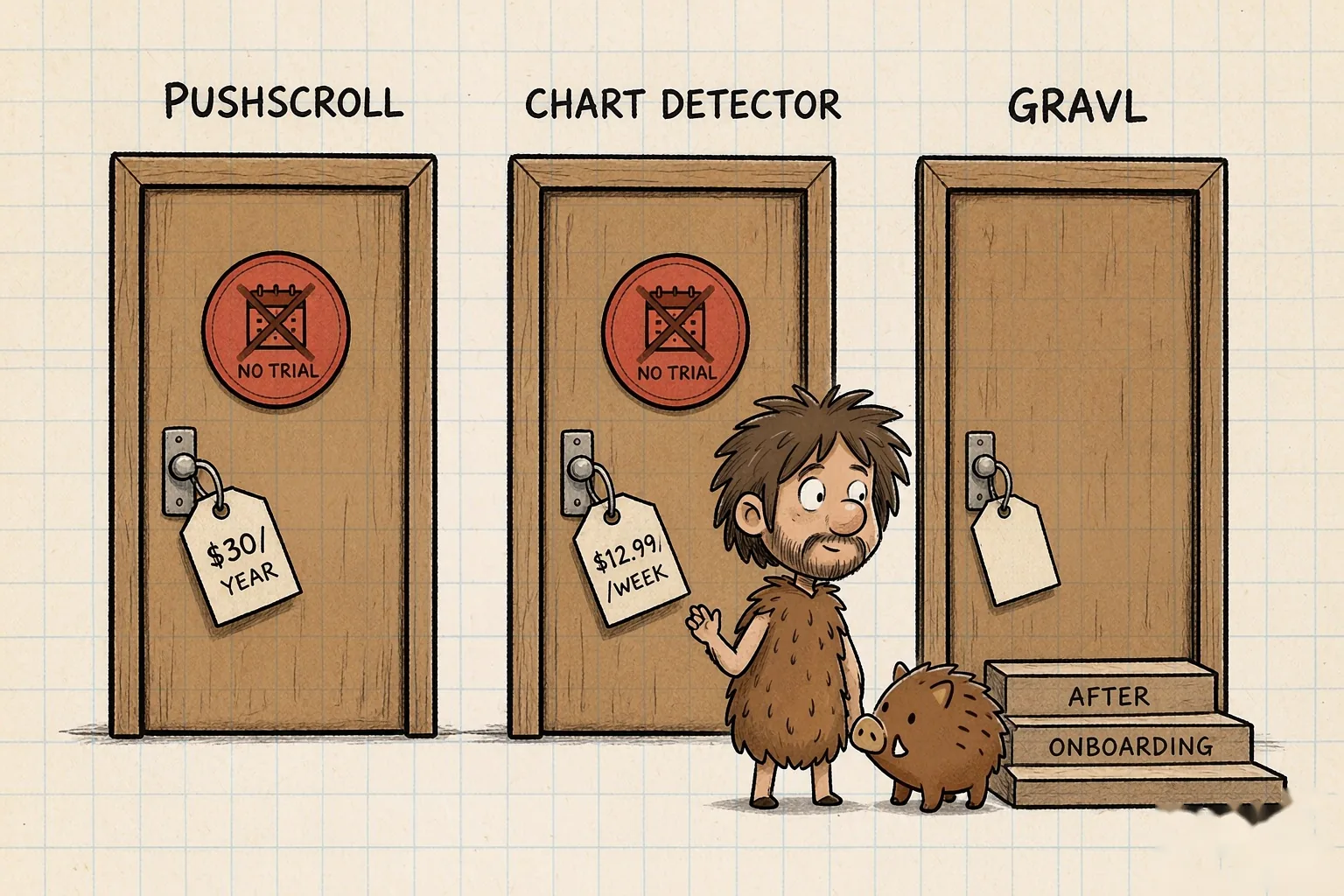
"Our business model is really simple. We just make everyone pay. It's a hard wall, and it takes around $30 a year."
Chart Detector, an app that reads stock charts from a photo:
"We have a hard paywall. We don't offer any free trials or something like that."
That second quote is the part most founders skip past. A hard paywall does not require a trial. PushScroll and Chart Detector both run with zero free days. You see the product, you see the price, you decide.
If the product does not exist yet, this is a different problem. That one is about selling before you build, not about gating something that already works.
Three signals your free tier is not working
Across the five failures, three signals show up before the founder changes anything.
1. Revenue is flat while usage is not. Monai had users. It also had $300 a month, for 18 months. The product was being used. The free tier was doing its job as a product and failing as a business.
2. Trial-to-paid is low and you cannot explain why. PropGPT had a 45% download-to-trial rate and a 13% trial-to-paid rate. The top of the funnel was fine. The bottom was not. That gap is where the product stopped delivering, not where the marketing stopped working.
3. Your free users cost real money. Bible Buddy hit $15,000 a month in platform fees before it had revenue to cover them. Rabbit Holes paid for AI calls on every free trial. If your marginal cost per free user is above zero, a free tier is a subscription you are paying on behalf of strangers.
None of these signals says "charge more." They say "you are already paying for this, and you are not collecting."
Five founders who switched, and what they measured
The switch itself is the part nobody writes about. Here is how each of them did it.
Monai: free tier to hard paywall with a 7-day trial.
Flo used RevenueCat, the subscription infrastructure tool. She relied on it for the revenue dashboard, but mostly for one feature:
"I use RevenueCat to show the revenue stats, of course, but also most importantly to do A/B tests."
She tested the free tier against a hard paywall with a trial. The hard paywall won. Revenue went from $300 a month to over $35K MRR in just over a year, part of that from a distribution deal with a content creator.
Mumigo: ads to subscriptions, then ten paywall experiments.
John's transit app made about $8,000 a month from banner ads until the pandemic wiped out ad revenue. He rebuilt it around subscriptions, then spent two to three months running experiments.
"Over the course of maybe two or three months with maybe 10 experiments, I was able to increase the conversion rate from 0.5% all the way up to 8%, just by optimizing the onboarding and paywall. Suddenly growth skyrocketed, going from around 8K a month to over $30,000."
Ten experiments. It wasn't one clever idea. That is the actual sample size behind "we tested our paywall."
Save Wise: subscription to lifetime.
Anish did not run an A/B test. The market told him in one day, by email. He added a lifetime plan and 97% of revenue moved there. The business reached about $25,000 a month with roughly 1,500 paying customers.
Rabbit Holes AI: web subscription to desktop, one-time purchase.
Prrenit cut the web app and moved to a desktop app with a one-time price, and pushed the AI cost onto users by having them bring their own API key.
He says people started paying as soon as he made the change.
He priced it at $29 under 100 users, then raised it to $49 once he crossed 100. Six months later: $80,000, about 1,200 users.
PropGPT: trial to hard paywall, after rebuilding the product.
This one is the exception. The switch was not just a pricing change. It was a product change first, then a pricing change. The founder is blunt about which one mattered.
"If your product is shit, nobody's going to buy it."
*If you are considering a switch, copy Mumigo's shape, not his numbers: pick one variable, run ten versions, and give it two to three months.*
What the paywall looks like when it works
Three products in the dataset describe their wall, in varying detail.
Product | Where the wall sits | Trial | Price |
|---|---|---|---|
|
PushScroll |
Not described |
None |
$30/year, one tier |
|
Chart Detector |
Inside onboarding, with social proof |
None |
$12.99/week and $59.99/6 months |
|
Gravl |
After onboarding, before first sign-in |
Not described |
Not described |
Gravl's sequence is the one worth stealing. The app asks about your goal, experience, training frequency, and available equipment. Then it builds your plan. Then it shows the paywall.
"You get to this final screen where you get your plan, kind of a summary. Here we go: hard paywall before you sign in for the first time."
The user sees the output before seeing the price. That is not generosity. It is proof. The wall is asking for money after the product has already answered the only question that matters: does this thing work for me?
Chart Detector does the same thing in a different order. The founder puts social proof inside onboarding, before the wall, so the decision is made with evidence in view. He also recommends the no-trial version outright.
Notice what none of them describe: a countdown timer, a fake discount, an 'only 3 spots left' banner. The closest thing to a tactic is social proof placed where the user can actually read it.

The bill nobody puts on the pricing page
Free tiers are usually discussed as a growth decision. In this dataset they were also an operating cost, and two founders got the invoice.
Bible Buddy: $15,000 a month in WhatsApp conversation fees, before the product had revenue to cover them. The fix was not pricing. It was infrastructure, moving to a native app built by a contractor found on Upwork.
Rabbit Holes: AI inference on every free trial, paid by the founder. The fix was architectural, a desktop app where users bring their own key.
Neither fix was a price increase. Both founders changed the product, and both changes had the same effect as a paywall: they stopped paying for people who had not paid them.
*Before your next pricing decision, open your hosting and API bill and divide it by your free users. That number is your free tier's real price.*
When a free tier is the right call
The dataset does not contain a founder saying that this type of product should never use a hard paywall. What it does contain is a set of products where free access was structural, not generous.
Postiz is open source. Its self-hosted version is the free tier, and the paid product is the hosted version. That is not a giveaway. It is distribution: developers run it themselves, trust it, and pay when they want someone else to run it. The report on this dataset records 3,830 trials and a 21% trial-to-paid rate.
Monai ended up on a hard paywall with a trial, not a pure wall. For a habit product, a trial lets the product prove itself through use rather than through a screenshot.
From the shape of these cases, not from any founder's words, the pattern looks like this: if free users create value for paying users, or if the product only proves itself through repeated use, free access has a job. If free users only consume, the free tier is a cost center with a signup form.
That is a rule of thumb, not a finding. The dataset does not settle it.
What to do this week
- Calculate the cost of one free user. Hosting, API calls, support time. If you cannot fill in the number, that is the first thing to fix.
- Find one product in your category with a paywall and copy its order of events. Not its price. Its sequence: what does the user see before being asked to pay?
- Run one experiment, not a redesign. Change where the wall appears, or whether there is a trial, and hold everything else still for two to three months.
FAQ
Do hard paywalls convert better than freemium?
In this dataset, every founder who switched moved toward charging earlier, and every one of them reported better revenue afterward. That is a sample of people who chose to switch, not a controlled comparison. It tells you the direction, not the size of the effect.
How do I know my free tier is not working?
Three signals: revenue stays flat while usage grows, trial-to-paid is low and you cannot explain the gap, or your cost per free user is above zero and rising.
Should I offer a free trial with a hard paywall?
Both versions appear here. PushScroll and Chart Detector run no trial at all. Monai and Gravl use a trial or an onboarding sequence to prove value first. The common thread is that the user sees proof before the price, whether that proof is a plan or seven days of use.
When is freemium the right choice?
When free users create value for paying users, or when the product only makes sense after repeated use. If neither is true, the free tier is a bill you are paying on behalf of people who may never convert.
Should I charge from day one?
Two products here charge from day one with no trial at all: PushScroll and Chart Detector. Two use a trial: Monai and Gravl. The split follows the product. A tool that delivers its value in one screen can charge immediately. A habit product needs a few days of use before the price makes sense.
How long should I give a pricing change before judging it?
Mumigo ran ten experiments over two to three months. PropGPT needed four months of product work before pricing mattered. If a change is not moving conversion after a month, look at the product before you look at the price. And if the product itself is the problem, this piece on when to stop is the harder read.
What if my product is not good enough to charge for yet?
Then a paywall will not fix it. PropGPT is the clearest case: the founders rebuilt the product for four months before the pricing change worked. The paywall amplified a product that had become worth paying for. It did not create one.
---
If you are still deciding what to build, the free SaaS idea validation checklist is the place to start.
*The interviews in this piece come from public founder interviews. Figures are the founders' own, as stated in their interviews. This is a sample of founders who were interviewed because they built something, not a random sample of all products.*